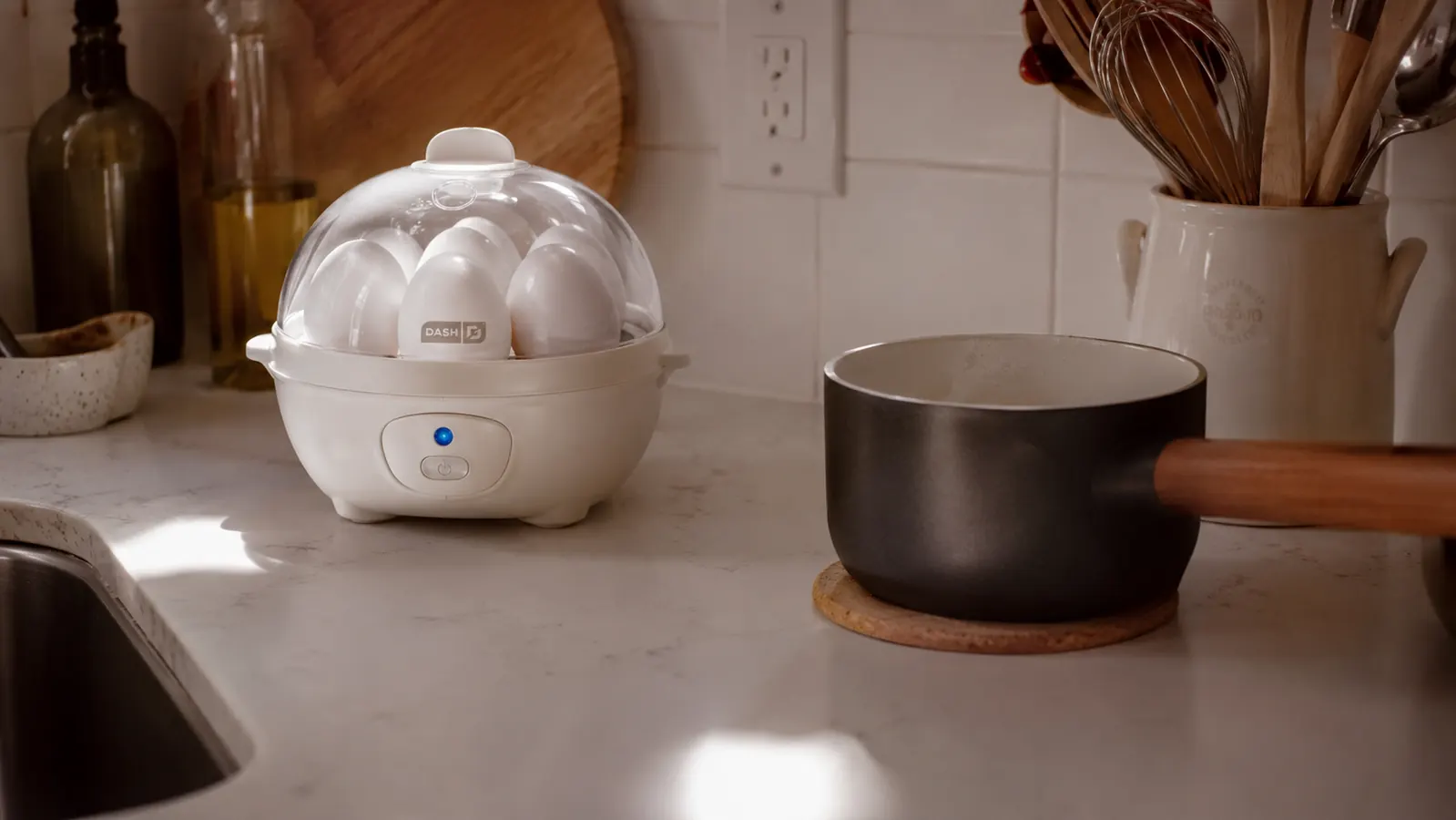
If you have ever pulled a rubbery, overcooked hard-boiled egg off the stove and thought, "I timed it exactly right this time," you already know the stovetop method's dirty secret: it lies. Water temperature, altitude, pot size, how cold the egg was when it went in, whether you covered the lid or not. All of it changes the outcome every single time. The Dash Rapid Egg Cooker, with 136,000-plus Amazon ratings at 4.6 stars, promises to fix all of that for less than the cost of a restaurant brunch. I wanted to know if it actually does, or if it is just another unitasker taking up precious counter space in a galley kitchen.
The short answer: the Dash wins this comparison on almost every practical measure. It is faster than most stovetop methods, more consistent, and requires zero monitoring. The stovetop is not useless, and if you already own a pot, it costs nothing. But for small-kitchen cooks who want reliable results without standing over a burner, the Dash is the better tool. Here is the full breakdown.
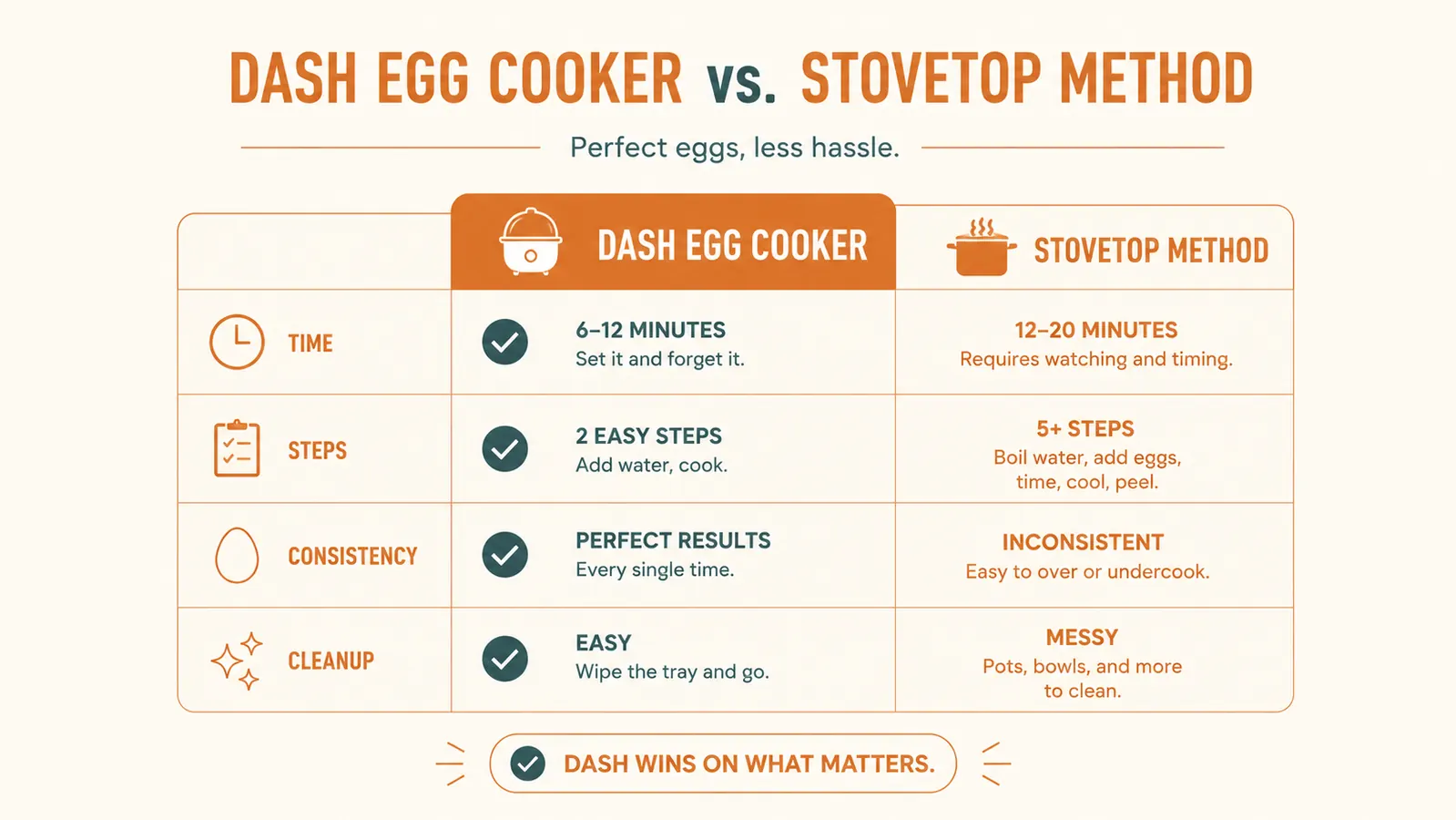
| Feature | Dash Rapid Egg Cooker | Stovetop Method |
|---|---|---|
| Active Cook Time (hard-boiled) | 12-14 minutes, fully unattended | 14-17 minutes, requires monitoring |
| Consistency Batch to Batch | Same result every time using the measuring cup | Varies with water temp, altitude, pot size, and egg chill |
| Counter or Burner Footprint | Roughly 6 inches wide, plugs in anywhere | Requires a free burner on your stove |
| Auto Shut-Off | Yes, beeps and powers off automatically | No, you must set a timer and stay nearby |
| Egg Styles Supported | Hard-boiled, soft-boiled, medium-boiled, poached, scrambled, small omelettes | Hard-boiled, soft-boiled, poached with extra care |
| Cleanup | Rinse the tray and measuring cup; both are dishwasher-safe | Wash the pot, the lid, and deal with any scalded waterline residue |
| Upfront Cost | Check today's price on Amazon | Free if you already own a pot |
| Skill Required | None. Fill, place eggs, press button. | Some. Timing and temperature judgment needed for perfect results. |
| Best For | Busy mornings, meal prep, consistent results in any small kitchen | Occasional use when you have a free burner and time to watch |
Tired of guessing how your eggs will turn out? The Dash Rapid Egg Cooker takes the guesswork out, every time.
136,000-plus Amazon buyers have already made the switch from stovetop. It is budget-friendly, fits on a six-inch square of counter space, and shuts off automatically when the eggs are done. No more hovering over a pot. No more overcooked yolks.
Amazon Check Today's Price on Amazon →Where the Dash Egg Cooker Wins
The biggest advantage is consistency. The Dash uses steam rather than boiling water, and the amount of steam is controlled by how much water you add with the included measuring cup. Fill it to the hard line and you get hard-boiled eggs. Fill it to the medium line and you get jammy yolks. Fill it to the soft line and you get a set white with a still-runny center. That measuring cup is the whole trick, and it removes the single biggest variable in stovetop egg cooking: your own judgment about when the water hit temperature and how that interacts with every other factor in your specific kitchen on this specific morning.
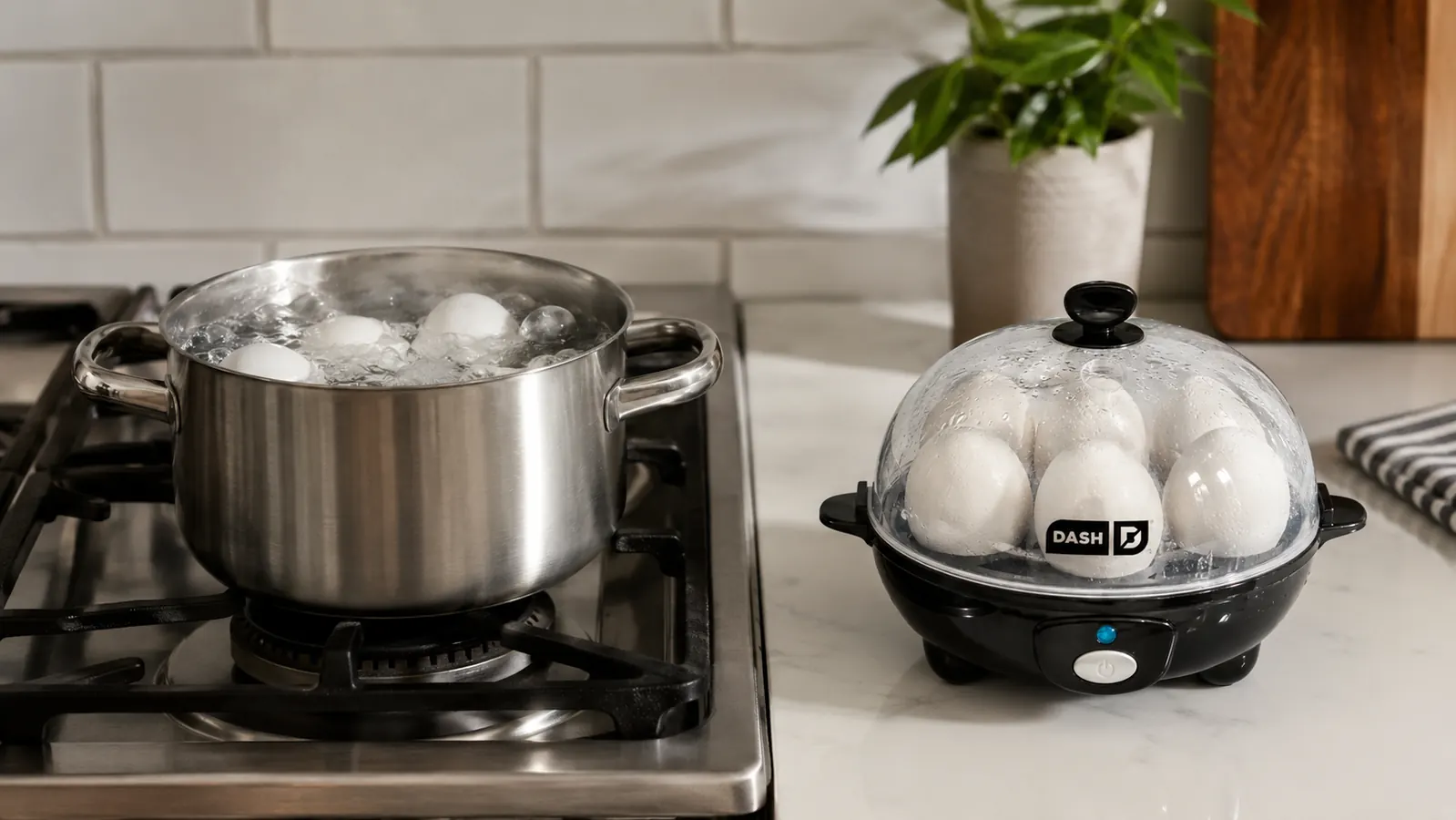
Speed is the second win, and it is worth clarifying how the math works. On a standard gas or electric stovetop, you are waiting for a full pot of water to reach a rolling boil before the clock even starts. That is typically 8-10 minutes for two quarts of cold water on a medium burner, more on an electric coil burner that struggles to transfer heat evenly. Then add your cook time on top. The Dash, by contrast, starts from room-temperature water in the small reservoir and reaches cooking temperature in under two minutes because it is heating a tiny amount of water, not a full pot. Total elapsed time from eggs-out-of-fridge to eggs-in-a-bowl runs about 12-14 minutes for hard-boiled. That is comparable to stovetop at best, noticeably faster at worst, and the real time savings comes from not having to watch the process at all.
Auto shut-off is the third win and the most underrated one. The Dash beeps when it is done and cuts power on its own. In a small apartment or dorm room, that means you can start eggs, walk away, make coffee, get dressed, and come back to perfectly cooked eggs without a single thought. On the stovetop, leaving a pot unattended on a burner is a genuine safety concern, not just an inconvenience. That difference in cognitive load matters more than people admit when they are comparing a free method to an affordable appliance.
Where the Stovetop Method Still Holds Up
The stovetop is not without its merits. If you already own a pot, the cost to cook eggs is zero. No additional appliance, no cord to manage, no item taking up a square of counter space. For someone who cooks eggs once a week and has a gas burner that heats fast and evenly, the stovetop is a perfectly workable method. You learn the timing, you use a good timer, and it works fine. It is also more flexible for larger batches: you can fit a dozen eggs in a standard stockpot with room to spare, while the Dash maxes out at six in its standard configuration. If you are making deviled eggs for a party or batch-cooking for a large household, the stovetop is probably the right tool.
Stovetop also gives you more direct control over peeling. One technique that many cooks swear by is the ice bath method: pull the eggs off heat at exactly the right moment, transfer them immediately into ice water, and the shell contracts away from the egg white, making it much easier to peel. The Dash achieves a similar result through steam, and in practice the shells on Dash-cooked eggs do peel cleanly, but cooks who have their stovetop timing dialed in and their ice bath ritual perfected will not find a dramatic peeling improvement with the Dash. It is roughly equivalent on that front.
The stovetop can cook eggs. The Dash just does it better, faster, and without babysitting. In a small kitchen where time and attention are both limited, that is not a small thing.
How the Results Actually Compare Side by Side
I ran the same batches in parallel: four hard-boiled eggs in the Dash, four in a small saucepot on the stove, using the same carton of eggs pulled from the same refrigerator shelf. The Dash eggs came out firm but not rubbery, with yolks that were fully set and a clean pale yellow color throughout. No grey-green ring around the yolk, which is the hallmark of an overcooked egg and something that happens easily when you overshoot stovetop timing by even two or three minutes, especially on an electric burner that holds heat after you cut it off.
The stovetop eggs were fine when I nailed the timing. But I ran three stovetop batches across two days and got slightly different results each time, even using a consistent 12-minute timer from boil. The water temperature was not identical each session, and on one batch the eggs went in slightly colder than usual after sitting on the counter while I prepared other things. The Dash batch looked essentially identical across all three runs. That reproducibility is the real argument for the appliance, not novelty or convenience for its own sake.
The poaching test was more lopsided. Poaching on the stovetop requires simmering water, a splash of vinegar, a gentle swirl, careful timing, and a slotted spoon. Done well, it is great. Done poorly, you get wispy egg-white tendrils floating around the pot and an undercooked yolk. The Dash's poaching tray produces what I would call a steamed-poached egg rather than a true water-poached egg. The white is slightly firmer and the shape is rounder, almost like an egg cup. For most purposes, the result is perfectly good. If you are a brunch purist who insists on a delicate water-poached egg, you may still want the stovetop for that specific task. For a practical weekday breakfast, the Dash version is more reliable and far less stressful.
The stovetop can do it. The Dash just does it better, faster, and without babysitting.
If you are still on the fence, check what 136,000-plus buyers said. The verdict is consistent: it works, it is easy to clean, and it does not take up much space. At current pricing, it is one of the lowest-risk kitchen buys available.
Amazon Check Today's Price on Amazon →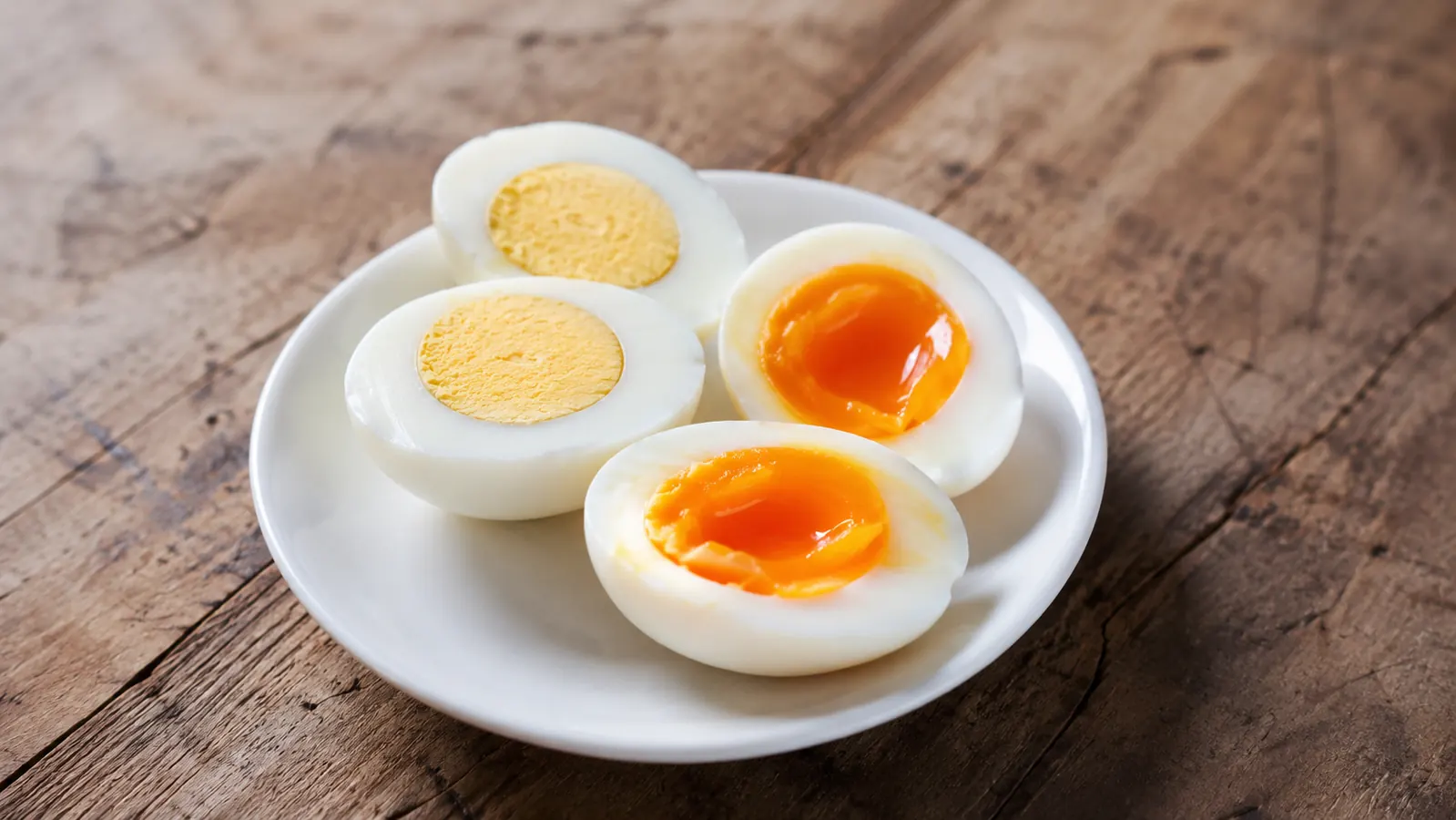
Who Should Buy the Dash Egg Cooker
The Dash makes the most sense for people who eat eggs regularly, at least three or four times a week, and who find the stovetop method unreliable or annoying. That includes apartment renters dealing with electric coil burners that heat unevenly, students making breakfast in a dorm room or shared kitchen, RV owners who want to conserve propane on a limited tank, and anyone doing weekly meal prep who needs a consistent hard-boiled result every Monday morning without thinking about it. It is also a strong buy if you are new to cooking and have not yet developed the timing instincts that come with years of stovetop practice. The measuring cup does that work for you.
It is also the right choice for anyone who has limited attention in the morning. If your routine involves coffee, getting dressed, checking messages, and packing a bag all at once, the Dash fits into that chaos in a way that a pot on the stove simply does not. You start it, you forget it, it beeps. That is worth the modest price to a lot of people. You can read our long-term Dash Egg Cooker review for a deeper look at how the appliance holds up over six months of daily use, and check our guide on how to meal prep a full week of eggs with the Dash if you want to get the most out of the cooking cycle.
Who Should Skip It and Stick with the Stovetop
If you make eggs infrequently, say once or twice a month, the stovetop is probably fine. The Dash earns its counter space through regular use, but if it sits in a cabinet for weeks at a time, you might as well use the pot you already own. Similarly, if you regularly cook large batches of eight or more eggs at once, you will hit the Dash's capacity limit and need to run multiple cycles, which erases most of the convenience advantage over a single large pot of boiling water.
There is also a counter-space reality check. The Dash is compact, roughly the size of a small toaster, but it is still a dedicated appliance with one primary job. If your kitchen has truly limited surface area and every inch is already occupied by something that earns its place daily, you have to decide whether consistent eggs justify the footprint. For most small-kitchen cooks who eat eggs more than twice a week, the answer is yes. But it is a fair question to ask before buying. If you are in a true micro-kitchen with almost no usable counter at all, a small pot and careful stovetop timing might be the more honest choice for your situation.
If consistent eggs matter to you, this is the most honest trade you can make in a small kitchen.
You are not replacing skill with a gadget. You are removing the most inconsistent part of egg cooking, which is the boiling water. The Dash uses measured steam that is the same every single time. In a kitchen where every minute and every burner counts, that is practical, not precious.
Amazon Check Today's Price on Amazon →